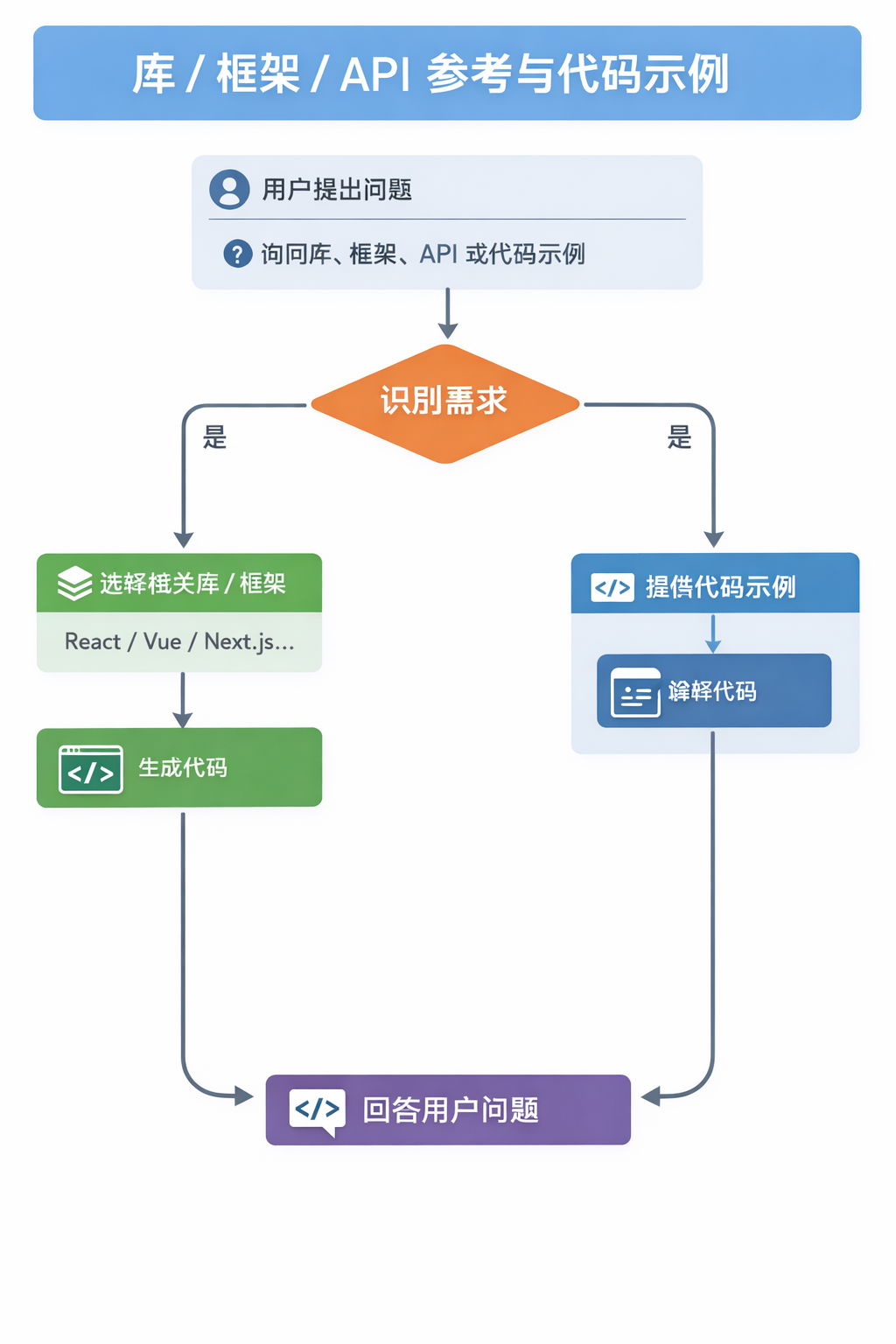
This skill should be used when the user asks about libraries, frameworks, API references, or needs code examples. Activates for setup questions, code generation involving libraries, or mentions of specific frameworks like React, Vue, Next.js, Prisma, Supabase, etc.
This skill should be used when the user asks to "test the harness", "run integration tests", "validate features with real API", "test with real model calls", "run agent loop tests", "verify end-to-end", or needs to verify OpenHarness features on a real codebase with actual LLM calls.
- 📁 agents/
- 📁 references/
- 📄 SKILL.md
在使用 MCP 做前端 JavaScript 逆向时使用,适用于签名链路定位、页面观察取证、本地补环境复现、VMP 类插桩分析、AST 去混淆与证据化输出。
Strategic research companion for Codex. Use when the user wants to brainstorm research directions, evaluate ideas, assess project strategy, or run a structured ideation session from vague topic to pursue/park/kill decision.
Use when the user needs to run GitNexus CLI commands like analyze/index a repo, check status, clean the index, generate a wiki, or list indexed repos. Examples: \"Index this repo\", \"Reanalyze the codebase\", \"Generate a wiki\
Add /compact command for manual context compaction. Solves context rot in long sessions by forwarding the SDK's built-in /compact slash command. Main-group or trusted sender only.
Load environment variables from a .env file into process.env for Node.js applications. Use when configuring apps with environment-specific secrets, setting up local development environments, managing API keys and database URLs, parsing .env file contents, or populating environment variables programmatically. Triggers on requests involving .env files, process.env, environment variable loading, twelve-factor app config, or Node.js secrets management.
Semantic search over past Claude Code and Codex conversations and memories. Use when the user wants to recall, find, or reference something from a previous coding session — e.g. "what did we discuss about X", "find that conversation where we fixed Y", "search my history for Z".
Guides stable API and interface design. Use when designing APIs, module boundaries, or any public interface. Use when creating REST or GraphQL endpoints, defining type contracts between modules, or establishing boundaries between frontend and backend.
How to use the Adaptyv Bio Foundry API and Python SDK for protein experiment design, submission, and results retrieval. Use this skill whenever the user mentions Adaptyv, Foundry API, protein binding assays, protein screening experiments, BLI/SPR assays, thermostability assays, or wants to submit protein sequences for experimental characterization. Also trigger when code imports `adaptyv`, `adaptyv_sdk`, or `FoundryClient`, or references `foundry-api-public.adaptyvbio.com`.
- 📁 references/
- 📄 README.md
- 📄 SKILL.md
Interactive lesson-level quiz for Claude Code tutorials. Tests understanding of a specific lesson (01-10) with 8-10 questions mixing conceptual and practical knowledge. Use before a lesson to pre-test, during to check progress, or after to verify mastery. Use when asked to "quiz me on hooks", "test my knowledge of lesson 3", "lesson quiz", "practice quiz for MCP", or "do I understand skills".
- 📁 references/
- 📁 scripts/
- 📄 SKILL.md
Convert Markdown documents to professionally typeset PDF files with reportlab. Handles CJK/Latin mixed text, fenced code blocks, tables, blockquotes, cover pages, clickable TOC, PDF bookmarks, watermarks, and page numbers. Supports multiple color themes (Warm Academic, Nord, GitHub Light, Solarized, etc.) and is battle-tested for Chinese technical reports. Use this skill whenever the user wants to turn a .md file into a styled PDF, generate a report PDF from markdown, or create a print-ready document from markdown content — especially if CJK characters, code blocks, or tables are involved. Also trigger when the user mentions "markdown to PDF", "md2pdf", "any2pdf", "md转pdf", "报告生成", or asks for a "typeset" or "professionally formatted" PDF from markdown source.


